
Perimenopause vs Menopause: 🤷🏻♀️ What’s The Difference
People use these terms interchangeably but they are actually different stages of a long arduous process in a woman’s hormonal transition. Think of the entire process like puberty in reverse - delightful huh? Does the distinction matter? Yes, actually it does in regards to how you feel and the treatment options. In this article we will review the process of reverse puberty, when to expect what, and what treatment options exist.

Much like the phases of the moon our hormones follow predictable patterns of ebb and flow. This happens throughout the month and throughout our aging process.
What Is Perimenopause?
Perimenopause means "around menopause." It is the transitional phase leading up to menopause when hormone levels begin to fluctuate. For most women, perimenopause starts between age 35-45. It can be a rapid progression to full menopause, the prime example of that being after having a hysterectomy. But in most instances it drags out an insufferably long period of time ~ 10 years or so.
Testosterone
When discussing perimenopause we tend to focus on the erratic interchange between Estrogen and Progesterone and that will be the focus of this discussion, however it bears noting that Testosterone does play a role here as well. So let’s talk Testosterone for a brief minute. Testosterone is often thought of as the “male” hormone, and much like men, as opposed to women, this hormone follows a pretty predictable pattern. It surges during puberty (hello acne and sex drive) and then gradually falls as we age. By the time we are menopausal they’re isn’t much left (which is probably why that sex drive feels more like a chore these days). There are other conditions in which the Testosterone level is low at earlier ages in life and we will have to discuss that separately (think: birth control). Low Testosterone can feel like:
Low Sex Drive | Fatigue | Afternoon Slump | Brain Fog | Poor Motivation | Joint Pain | Difficult Workouts | Can't Lose Weight | Anxiety | Irritability
〰️
Low Sex Drive | Fatigue | Afternoon Slump | Brain Fog | Poor Motivation | Joint Pain | Difficult Workouts | Can't Lose Weight | Anxiety | Irritability 〰️
Progesterone
Back to the main players here: first comes Progesterone problems. Typically, the first hormone to become deficienct in perimenopause is Progesterone. Let’s go back to basics for a second to help clarify things. A normal cycle of reproduction starts with eggs. As women, we store our eggs inside little houses called follicles. These are fluid filled sacs that nurture the egg until it’s called from the batter’s box. During the first half of our period as the follicles start to prepare themselves they trigger Estrogen levels to rise. When the player on deck is mature it causes a surge in upstream hormones and the follicle ruptures - therby expelling the egg jet propulsion style into the fallopian tubes to begin its path towards its new home to await the perfect sperm. This is ovulation. When life is beautiful; we walk Snow White style; birds appear to revel in our joy. Men experience the women who enjoy their company - in and out of the bedroom. Life is perfect. Then when no sperm rises to meet the occasion women segue into the dark soul of the night. Just kidding, I meant luteal phase. The time when Estrogen makes its’s sad exit and Progesterone comes in to clean up the mess. When we are young and nubile we have plenty of Progesterone and this helps ease the transition post ovulation. During the few days before menstruation begins our Progesterone plummets (alongside Estrogen) and this feels rough. In perimenopause we do not make enough Progesterone and this starts the season of reverse puberty.
Your monthly cycle simplified looks like: ⬆️ Estrogen → 🥚 Ovulation → ⬆️ Progesterone → ⬇️ Estrogen + ⬇️ Progesterone → 🩸 Period
We make less Progesterone because we have fewer viable eggs and so some months we do not actually ovulate (but we can still menstruate - delightful 🙄) and therefore there isn’t much stimulus to make Progesterone. Periods will eventually become irregular.
A woman can have normal Estrogen levels, regular periods, and STILL have declining production of Progesterone. This is the hallmark of perimenopause. Everything looks “normal” on the outside and on labs but deep down you know you don’t feel right. That is because you are experiencing the symptoms of low Progesterone which can feel like:
Anxiety | Difficulty With Sleep | Irritability (Remember Tawanda From Fried Green Tomatoes?) | Worse PMS | Breast Tenderness
〰️
Anxiety | Difficulty With Sleep | Irritability (Remember Tawanda From Fried Green Tomatoes?) | Worse PMS | Breast Tenderness 〰️
Estrogen
As it progresses in years the Progesterone continues to decline and at some point the Estrogen starts to drop as well. This process is not linear. It looks more like your favorite theme park’s ride. Wild swings → you’re unpredictable in many ways but probably commented on the most by the “well meaning” people in your life → you’re crazy moody. For about a decade (or more) of your life. Yes, you are in fact a peach to live with. Even worse than that - you feel rough. And you probably have kids and spousal needs and are at the height of your career and maybe throw in an aging parent. Oh, and you’re not sleeping well. It’s a recipe for some justifiable mood swings.
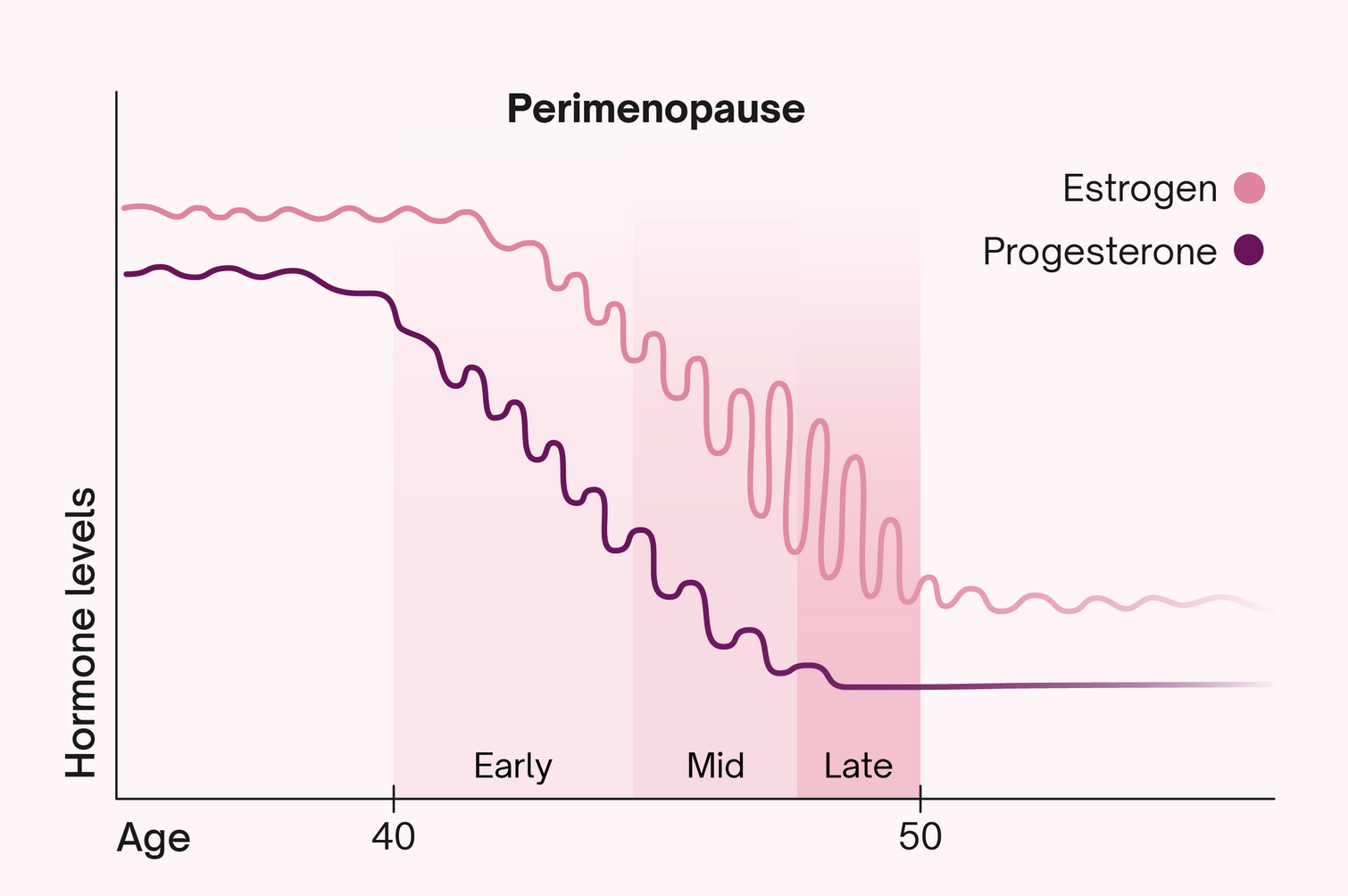
At some point when the universe decides it’s done with the flogging your Estrogen starts to really drop. Like really for real drop. And those wild swings - here’s the good news - they start leveling off. Here’s the bad news - now you just stay on the low side of things. Now you are entering the stereotypical menopause phase. Your periods streteched out in frequency to non existent (this is the only real upside). You may, or may not, have the classic hot flashes seen on TV. But you may have any of the below laundry list of delights:
Night Sweats | Palpitations | Tears | Depression | Lack of Motivation | Joint Pain | Difficulty Achieving Orgasm | Breast Tenderness | Gum/Teeth Pain Or Mouth Sores | Dry/Itchy Skin/Hair | Spare Tire Around Your Belly | Vivid Dreams | Difficulty Staying Asleep |
〰️
Night Sweats | Palpitations | Tears | Depression | Lack of Motivation | Joint Pain | Difficulty Achieving Orgasm | Breast Tenderness | Gum/Teeth Pain Or Mouth Sores | Dry/Itchy Skin/Hair | Spare Tire Around Your Belly | Vivid Dreams | Difficulty Staying Asleep | 〰️
What is Menopause?
Welcome to menopause which is defined by:
No menstruation for 12 months or more
Infertility
The average age of menopause in the United States is approximately 51 years old. Once menopause occurs, the ovaries have largely stopped producing eggs, and estrogen and progesterone levels remain consistently low. After menopause, a woman enters the postmenopausal stage, which lasts for the remainder of her life. Some women find that symptoms improve after menopause, while others continue to experience bothersome symptoms for years.
Do I Need Hormones?
Like most ambiguous answers the same applies here: it depends. Modern medicine argues it is not a medical necessity to balance/replace hormones. It is symptoms based. Some women sail through menopause with nary a care. Others have mild and manageable symptoms. For some it is a very rough season of life. If you have any of the above symptoms and they are disruptive to your life I argue that quality of life is an essential need. Beyond that, there are non-overt problems associated with hormonal deficiencies that will improve or be avoided if hormones are optimized. Exampes are: dementia, osteoporosis, high cholesterol/lipid levels, and urinary tract infections just to name a few.
The Bottom Line
Perimenopause and menopause are natural stages of life, but that does not mean you have to suffer through symptoms that affect your daily activities and well-being. Understanding the differences between these stages can help you recognize what your body is experiencing and identify treatment options that may improve your quality of life.
At Alpha Wellness Clinic, we provide individualized hormone evaluations and treatment plans designed to help women navigate perimenopause and menopause with confidence, energy, and vitality. If you want a comprehensive hormonal evaluation and a personalized plan schedule your complimenatry consultation visit by booking as a new initial consult here: